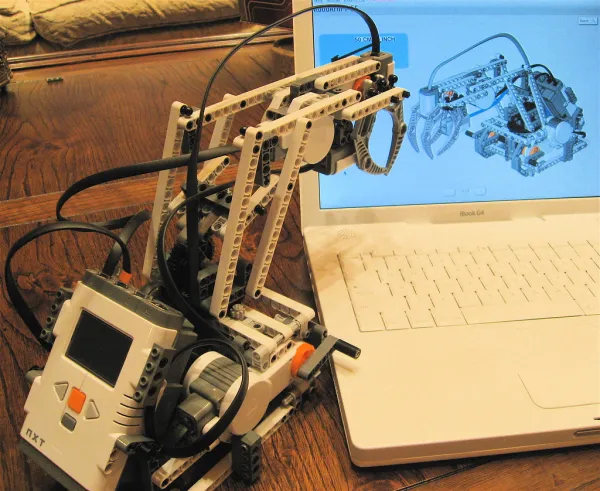
In recent years, LEGO has moved far beyond being a traditional toy and has become a powerful educational tool in robotics and STEM education. By combining familiar building bricks with programmable technology, LEGO robotics platforms such as Mindstrins, WeDo, and Machines and Mechanisms kits help introduce children to engineering, coding, and problem-solving in an engaging, hands-on way. Research consistently shows that this approach is especially effective for young learners.
One of the most influential studies on the topic is LEGO Mindstorms and Elementary Learning Outcomes by Vidushi Chaudhary. Their experimental research found that elementary students who used LEGO Mindstorms EV3 kits demonstrated significant improvement in computational thinking, programming skills, collaboration, and problem-solving abilities. The structured lessons encouraged students to design, test, and refine robots, allowing them to learn through trial and error while working in teams. This process mirrors real engineering practice and helps students become comfortable with both failure and persistence.
Similar benefits were observed in younger age groups. Agrawal and Sureka reported that LEGO Machines and Mechanism kits supported children ages 7-10 in developing foundational engineering knowledge and teamwork skills. By physically constructing moving systems such as gears and levers, students could see abstract concepts come to life, making learning more concrete and accessible.
Beyond individual classrooms, large-scale research trends also support LEGO’s educational value. A recent bibliometric review published in Scientometrics found that academic research on LEGO-based robotics is rapidly growing. The review concluded that combining LEGO bricks with robotics often increases students’ motivation, confidence, and engagement, particularly among underrepresented groups in STEM. However, it also emphasized that access to resources and teacher training play a major role in how successful these programs are.
Hands-on classroom studies reinforce these findings. A 2020 paper presented at the American Society for Engineering Education examined how LEGO robots function as “learning artifacts” in STEM classrooms. The researchers found that programmable LEGO systems help scaffold scientific inquiry and engineering design, allowing students to test hypotheses, collect data, and refine solutions in meaningful ways.
LEGO robotics is also widely used outside traditional classroom settings. Reviews of STEM camps and informal learning programs show that platforms like Mindstorms and WeDo positively affect students’ computational thinking, interest in STEM careers, and self-efficacy, though outcomes depend on how well activities are structured. Competitive programs such as FIRST LEGO League and the World Robot Olympiad further extend learning by challenging students to solve real-world problems while practicing teamwork, communication, and project management.
Even at advanced levels, LEGO continues to play an important role. The BricksRL project demonstrates that LEGO robotics can support research in artificial intelligence and reinforcement learning, proving that the same tools used by children can scale to sophisticated experimentation.
Overall, LEGO robotics provides a unique bridge between play and education. By making robotics approachable, visual, and interactive, LEGO helps children build not only robots, but also confidence, creativity, and essential skills for the future of STEM.
Sources:
https://arxiv.org/abs/1610.09610
https://link.springer.com/article/10.1007/s11135-025-02186-8
https://peer.asee.org/examining-the-role-of-lego-robots-as-artifacts-in-stem-classrooms
https://www.mdpi.com/2227-7102/15/2/143
https://www.robot-academy.com/lego-robotics-and-improvements-in-students-academic-performance/