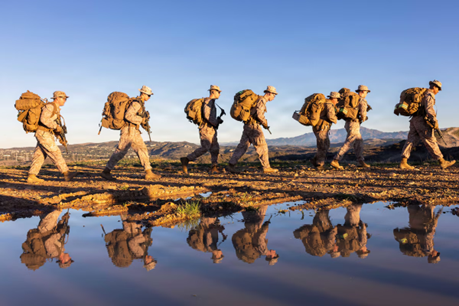
Joining the U.S. military, whether it be the Army, Marines, Coast Guard, Air Force, Navy, or even Space Force, is known to entail a long stretch of intensive disciplinary training that can be seen as unenjoyable and torturous. While it is true that enlistment requires recruits to endure extreme physical and mental challenges, it is easy to overlook the adventure that training and enlistment in the military bring. The development, personal growth, teamwork, and experiences that are unique to basic training offer an unusual perspective into the adventure of joining the U.S. Armed Forces.
One such hero who answered the call to serve is Steve Columbia, who served as a civil affairs specialist in the 38th Bravo. Upon enlistment, he first underwent basic training at Fort Jackson in South Carolina. Columbia described his basic training experience as beginning with two days of no sleep, enforced by drill sergeants so that recruits from different time zones and countries could acclimate and be on the same sleep schedule. He was placed in a barracks room with 20 other people within the confines of the Fort, and from then on was exposed to the shock of what basic training is. “They didn’t really tell you what to expect, so your experience is raw.”, Columbia stated. “Everything is in cadence and marching. When with more than three people, you must march.”
Like all recruits, Columbia faced numerous challenges during basic training, a mandatory experience that all recruits must undergo, regardless of their specialized position. He joined in January, and in basic training, you are never allowed to have your hands in your pockets. “The biggest challenge was the cold, and shooting was hard with cold hands.” Columbia also stated that there “was lots of uncertainty” due to not being in control during the initial weeks in training. Upon completing basic training, Columbia moved on to Fort Brad for Military Occupation Specialist (MOS) training, where he was trained to be a civil affairs specialist. During that intensive training, he reported “Not knowing whether it was night or day.”
Despite the challenges of both basic and MOS training, Columbia found many victories in the struggles, the most notable being his apparent immunity to CS (tear) gas. All recruits, during basic training, must be exposed to CS gas to simulate the experience of an enemy gas attack. When Columbia underwent this, he claimed to have “No reaction to the gas at all.” Drill sergeants retested him multiple times, and, according to Columbia, they called in the battalion commander to observe, who was also perplexed at Columbia’s immunity.
During his time serving, Columbia was stationed in both Africa and Germany. When asked if his training fully prepared him for his service in the army, Columbia stated, “Yes, and no. It had to do with good leadership. Poor leadership was the blind leading the blind.” He also added that, if he had the chance to serve again, he “one-hundred percent would.” With what Columbia carried with him from his service in the army, the adventure of basic training is clear. He came out, “being able to react in unnatural scenarios. Calm in the chaos.” His strong mentality is evident, as seen in another veteran who served, Pennridge Superintendent Dr. Angelo Berrios.
Dr. Berrios served as a Marine in the 22nd Marine Expeditionary Unit, Special Operations Capable (MUESOC), from 1991 to 1995, as both an infantryman and a machine gunner. As all recruits do, he underwent his basic training before his MOS. Like Columbia, Dr. Berrios did not feel completely prepared by basic training, stating, “It gets you physically in good shape. You learn the very basics and get adjusted to military life. True training as an infantry Marine happens after boot camp.” He further described basic training as “Not a deep dive into what the Marine Corps is all about.”
Dr. Berrios then moved on to MOS and learned more about “how to shoot, how to disassemble weapons, and how to clean them.” He even related his training to that of Pennridge teachers, citing “Like our teachers, we constantly have training.” Going beyond his training, Dr. Berrios also served two deployments in three separate operations in Bosnia and the Adriatic Sea. When reflecting on his experiences, he said, “I feel like I served our country. I wish more young people would think about serving our country. I think there’s a lot of value in that.” As Columbia did, he also learned core values which still resonate today: “You learn some core values: being on time and being respectful. You have to be able to handle a level of stress.” He also stated, “A good Marine is quick on his or her feet.”
The overlooked adventures of joining the U.S. military are apparent through the testimonies and accounts given by both Steve Columbia and Dr. Berrios. Both answered the call to serve their country, and both learned the core values that basic training, MOS, and regular service have to offer. To this day, both Dr. Berrios and Columbia apply their mental toughness and decision-making skills in their everyday lives, with Dr. Berrios managing Pennridge School District and Columbia managing his successful company. They attest to the benefits and growth that military service provides, and both would, if given the chance, faithfully serve their country again.