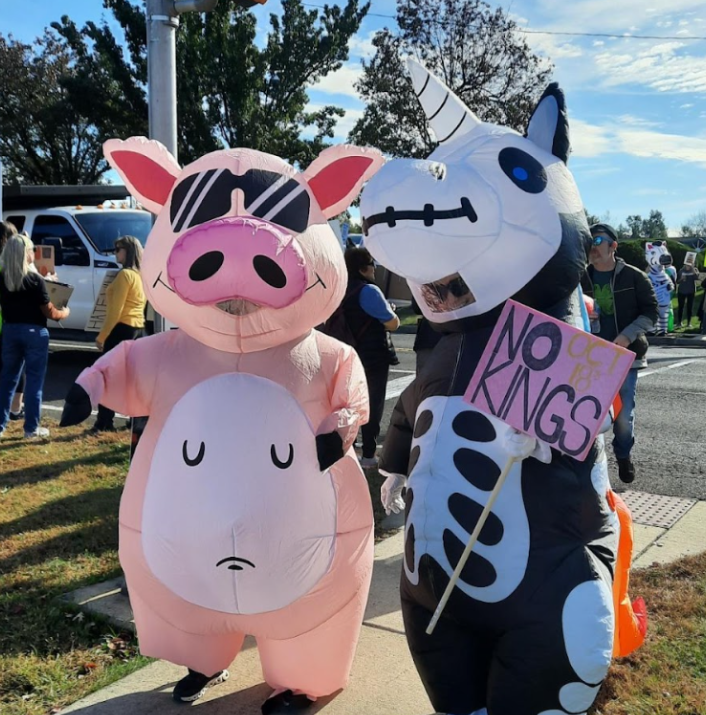
The No Kings Protests were comprised of two large, organized public protests by groups such as the 50501 Movement and Indivisible within the United States of America to protest against President Donald Trump in 2025. The name No King stems from President Donald Trump’s statements about serving as president beyond his second term. The first protest took place on June 14, 2025, to show dissent within the American public with President Donald Trump’s military parade, which also took place on his birthday, in Washington, D.C., for the 250th anniversary of the Army. The first protest took place at about 2,100 sites, smaller than the second No Kings Protest on October 18, 2025, which involved more than 2,700 sites across the U.S. The second protest made history as the largest in American history, reflecting U.S. citizens’ unrest with the newly elected president. More than five million protesters showed up in June, and the following phase of the No Kings protest drew more than seven million activists. Large populated cities in America came together as a unified group to show their support for the protest in locations such as Chicago, New York City, Philadelphia, Los Angeles, and Seattle, with protesters holding signs that read “Democracy not Monarchy.”
Protests have been powerful forces for political and cultural change in both American and global history. Many protests in America have led to positive changes. Labor protests of the 1930s helped secure the creation of industrial unions, increasing wages and job protection. Civil Rights protests dismantled Jim Crow laws and expanded political representation for Black Americans. The 1913 Suffrage Parade propelled women’s political rights, and the Delano Grape Boycott of the 1960s secured better working conditions for farm workers. These examples reflect large-scale demonstrations that caught the nation’s attention and drove change.
Local resident, Kevin Walsh from Perkasie, Pennsylvania, was one of many who took part in the Perkasie No Kings Protest on October 18. The protest location, organized by the Pennridge Community Alliance and posted on platforms like Facebook, was how Walsh learned about and became motivated to attend. According to Walsh, “the protest was organized to be peaceful and bring together like-minded people to show unity among people who feel opposed to the current political policies in D.C.” Walsh explained how social media played a vital role in the spread of knowledge of what was happening at each protesting site, saying that without social media, “it would make it more difficult to convey what actually happened at the event” in regards to staying peaceful and how large the turnout was. He showed relentless support for the use of social media for political change, as it can be used as evidence of what happens when large groups of people come together to share similar views on a topic.
Holly Greene, who resides in Portland, Maine, has participated in previous protests, including protests against Donald Trump during his first campaign. Recently, she continued to speak out by participating in the No Kings Protests in Portland, Maine. Online social groups, such as the Rose Mont group and Indivisible, were where Greene began to hear plans for the protest as neighbors posted updates, Greene explained that while her neighborhood does spread details verbally, social media proves to “get to broader scopes of people, allowing those who may be moderate political sides also to view the news and get notified on multiple platforms”. She described how social media allows “the world to see the numbers pictures,” making her feel good because there are others who are like-minded and providing hope that others feel the same way as her about the current political state.
Mary McKay, a resident of Perkasie, Pennsylvania, has attended protests since the 1990s, beginning in Minneapolis, Minnesota, during a rally for women’s reproductive rights and continuing through the 2025 No Kings events. McKay describes protests as empowering, emphasizing how they amplify individual voices and ensure you are heard among hundreds or even thousands of people. McKay’s motivation behind protesting lies in its true purpose, which she emphasizes when she states, “Freedom of speech is paramount to a democracy, and protests allow us to do just that.” She also pointed out that modern protests are more easily organized and maintained through social media. As a member of the 50501, an online group, McKay stays informed about events, locations, and dates. “Social media also helps to demonstrate that the protests are real and not ‘fake news,’ as certain groups like to claim they are,” she adds. “It puts a face on what is happening in real time.”
To maximize the impact of protests, a few factors need to be prioritized as they consistently contribute to their success. There must be clear goals, strong cross-community coalitions, and consistency. Walsh, Greene, and McKay emphasized that protests are most effective when applied to broader political engagement, making sure that the energy spent protesting translates into voting and policy decisions. They also noted that protests build morale, amplify voices, and have become increasingly accessible with social media. This widespread use of social media is crucial, as the most up-to-the-minute news is being displayed for users to see, including political updates. Social activists who use the “viral” method of the internet to raise awareness and organize mass events by spreading information will be able to reach a greater audience. The No Kings Protests illustrate this point clearly, showing how public protests unite large groups of people across age groups and political identities. This extensive participation highlights how protests continue to serve as a powerful form of democratic expression. Ultimately, the movement demonstrates that collective action not only brings attention to an issue but also strengthens the democratic values at the heart of our nation.
Sources:
https://link.gale.com/apps/doc/CX3045302098/SUIC?u=perk75268&sid=bookmark-SUIC&xid=dd1630bb
https://link.gale.com/apps/doc/CX2461000013/SUIC?u=perk75268&sid=bookmark-SUIC&xid=a66bd233
https://www.livescience.com/16153-10-significant-political-protests.html
https://www.brookings.edu/articles/the-power-of-protest-in-the-us/
https://school.eb.com/levels/high/article/No-Kings-protests/650197