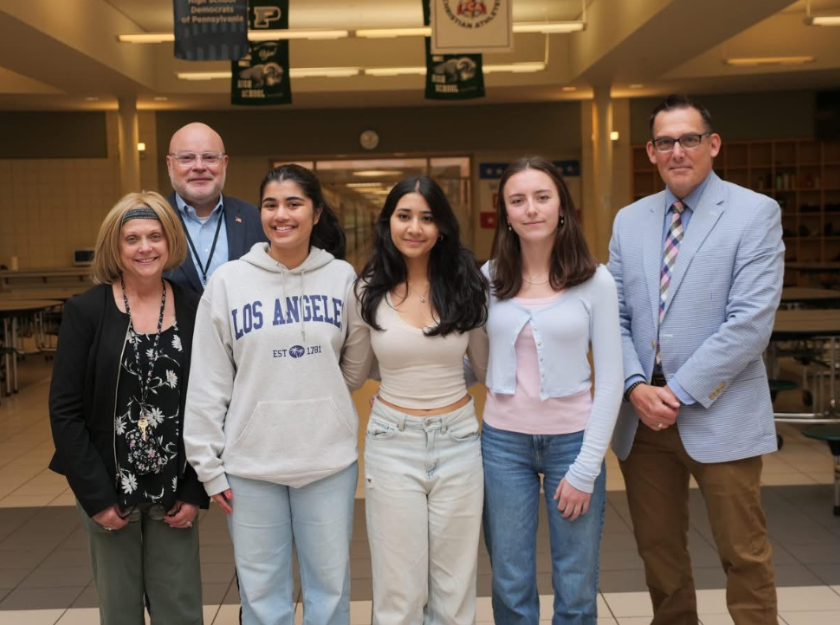
The NASA Drop Tower Challenge of 2025 gave high school students an opportunity to utilize their creativity and innovative thinking. The prompt for this challenge was to create a paddle wheel with the ability to spin in water when put in an environment with microgravity. The rotation of the wheel has to be due to the hydrophobic and hydrophilic properties of the wheel’s surface; no mechanical forces or chemical reactions are allowed. The contestants had to submit their proposals by October 31, 2024. After extensive brainstorming, research, and team discussion, Chloe Benner, Ananya Bhatt, and Surabhi Gupta (also known as Team CAS) came up with what became a nationally recognized idea. This team of three girls theorized that the capillary action of sponges could be used to propel their paddle wheel. In October of 2024, Team CAS had no idea this project would snowball into the greatest achievement of their high school careers. Their advisor, SueEllen Thomas, explains, “I had heard of other schools and students being involved with NASA, so when I came across this challenge, I thought it would be a great opportunity.” From October 2024 to May 2025, this team of three had their proposal accepted, created a prototype, had this prototype tested at NASA, wrote an academic paper, and placed third in this national competition. Although Team CAS was very excited about this achievement, they are even more excited about the prospect of it inspiring other girls to pursue their dreams in STEM.
If you walk into almost any advanced STEM class today, you will immediately notice the empty seats where girls should be. Despite decades of progress, the path for women in science and engineering is filled with stereotypes and obstacles. Currently, women only make up 26% of the STEM workforce, with engineering, physics, and technology sectors being the most underrepresented. This divide is not only seen in the workforce. Kimberly Destefano, a teacher at Pennridge High School who teaches both AP Physics C and AP Chemistry, said, “Over the years, the trend has always been that there are fewer girls taking physics classes than chemistry”. This year, only three girls are taking AP Physics C out of 21, while in chemistry, that ratio is 12 to 19.
According to her, the difference is not because of the abilities of the girls, but because of the perceptions and stereotypes surrounding physics. “People think that girls are not good at math, and since physics is very math-heavy, this thought process follows,” she explains. That stereotype alone is enough to push students off the STEM track after introductory courses. Destefano has also noticed a confidence gap with participation in classes. “In both classes, boys are more likely to participate than girls, especially in physics,” she explains. Many girls begin to opt out of STEM electives during their high school careers, and this trend is evident nationwide. While women dominate health sciences in college, there are only 32% of women in engineering roles, and many reports of being the only ‘women in the room’.
Social pressures outside the classroom also shape these decisions. From the rise of “trad wife” and “stay-at-home girlfriend” trends on social media to long-standing beliefs about who should be the primary caregiver, young women face a cultural tug-of-war between ambition and expectation. A Pew Research Center study found that many Americans still believe it’s better for mothers, not fathers, to stay home with children. Layer these messages onto media portrayals that overwhelmingly show men as scientists, engineers, and innovators, and the result is a powerful deterrent before girls even get the chance to discover their strengths.
But Team CAS proves that change is possible. When they placed third in NASA’s Drop Tower Challenge, they opened a door for countless other girls who doubted whether they belonged in STEM. The statistics are daunting, and the cultural headwinds are real, but every girl who raises her hand in class and every team like CAS that defies expectations is part of rewriting the narrative. Their paddle wheel, powered by capillary action in microgravity, is a fitting metaphor: sometimes the most powerful forces work quietly beneath the surface, drawing others upward against gravity itself. With supportive teachers creating opportunities and students proving what’s possible, the empty seats in STEM classrooms don’t have to stay empty.
Works Cited
Bate, Janne. “We Need to Talk about Media Portrayals of Women in STEM.” SRG, www.srgtalent.com/blog/we-need-to-talk-about-media-portrayals-of-women-in-stem.
Filipovic, Jill. “Opinion: There’s Nothing ‘Lazy’ about This Work-Life Trend.” CNN, 25 July 2023, www.cnn.com/2023/07/25/opinions/tiktok-lazy-girl-jobs-women-workforce-filipovic. Accessed 20 Nov. 2025.
McGuire, Luke, et al. “STEM Gender Stereotypes from Early Childhood through Adolescence at Informal Science Centers.” Journal of Applied Developmental Psychology, vol. 67, no. 67, Mar. 2020, p. 101109, https://doi.org/10.1016/j.appdev.2020.101109.
“The STEM Gap.” AAUW: Empowering Women since 1881, www.aauw.org/issues/education/stem/.