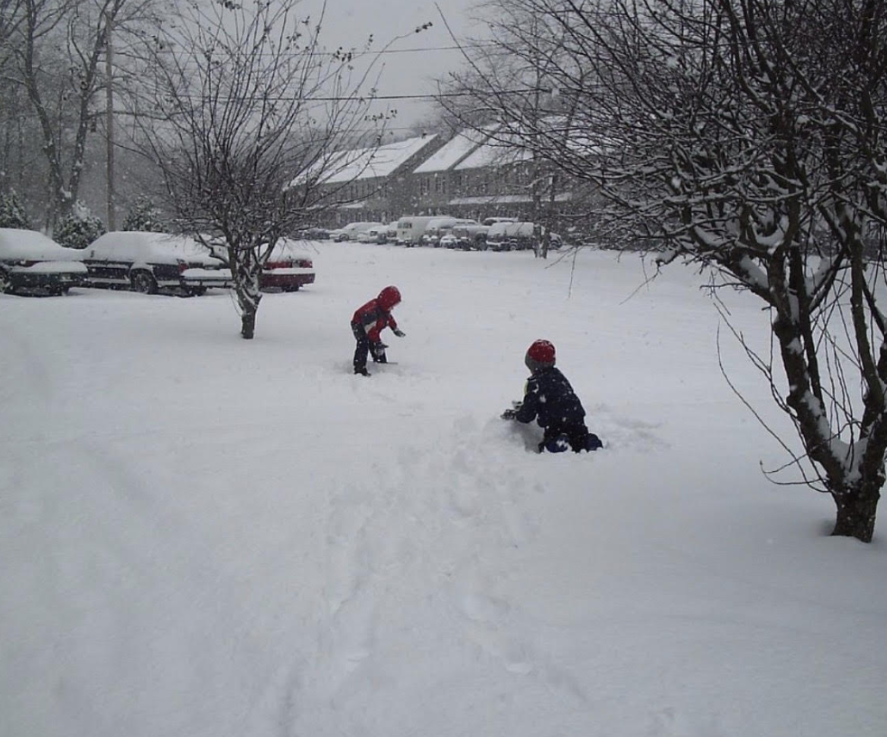
For decades, snow days were the ultimate childhood surprise; an unexpected morning announcement, the excitement of staying home, and hours spent sledding followed by warming up with hot chocolate. But with the rise of technology and remote learning, the meaning of a snow day has dramatically changed. What was once a carefree, fun snow day off has slowly shifted into a day still filled with schoolwork, screens, and expectations.
At Pennridge High School, AP Environmental teacher Richard Hampson has watched this transformation unfold year by year. “Snow days now are drastically different because of academic expectations,” he says. With his own children home, he admits snow days now mean far more screen exposure. “When there are snow days, my kids get way more screen time compared to daily,” Hampson explains. Even though technology helps avoid adding extra days to the end of the school year, Hampson adds that technology has hurt kids during snow days. “Without a doubt, how technology has been used has had a greatly negative impact. Snow days have now turned into asynchronous days.”
When it comes to his students, Hampson avoids adding extra stress. “I don’t assign a lot of work, usually just a video or two with a couple of questions,” he says. He supports giving students time to relax, but also thinks there should be some academic work getting done if there is an asynchronous day. “I think at a maximum, if it’s going to count as a school day, it should be 20 minutes per class, an hour and a half of work, and then snow activities.”
Pennridge Junior, Colbie Landherr, has also noticed a difference in snow days. She says her snow days today look very different from the ones she remembers when she was little. “Now there are usually asynchronous days. I spend my snow day usually catching up on my school work,” Landherr emphasized.
Landherr strongly prefers classic snow days. “On traditional snow days, I can have the day off. I like to relax, get away from the computer, and just spend time with my family and friends.” For Landherr, asynchronous days and learning drained much of the excitement. “I remember I would get excited to text my friends to meet up and play in the snow or go sledding. They’re so different now because the high school has assigned us laptops since ninth grade; they can easily assign us work on our days off,” Landherr stressed.
For parents, the shift is easier with time. Amber Bogart, mother of two young children, says technology has made snow days far easier to manage from a work perspective. “I don’t have a limit to screen time for when they’re home, but I also don’t want them on it all day. It just keeps them entertained when I need them to be because I do work from home some days,” Bogart says. “The biggest challenge with technology on snow days, though, would be them fighting over their iPads.” But even Bogart recognizes that convenience comes with a trade-off. “My kids do love playing in the snow,” she says. “But once we come back inside from playing in it all morning, they are ready to go back on their iPads to play.” She explains that the snow days now are different from when she was growing up. “While I was growing up, school would be cancelled completely, and we would go and play outside all day long, whereas now, schools can make their learning online to still do work without adding on extra days to the school year,” Bogart said. “I don’t see that many kids playing in my neighborhood on snow days because they’re all probably inside playing video games.”
School districts defend the shift, saying virtual snow days prevent the academic year from going into late June and maintain consistency in learning. But many teachers, students, and parents feel that a piece of childhood has been quickly replaced by responsibility and dread. As winter approaches and the weather becomes harder to predict, the debate over the future of snow days continues. For families today, snow days often mean laptops on the kitchen table instead of sleds by the door, proof that even the simplest traditions can be changed by technology.