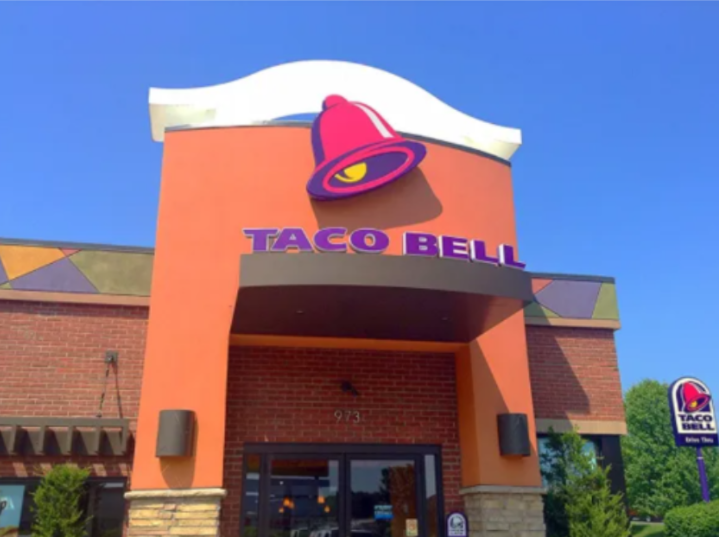
Increasing economic pressures mean customers are dining out less, which is causing fast-food restaurants industry-wide to face declining sales; except for Taco Bell of course. Taco Bell, the Mexican-inspired fast-food establishment that dates back to 1952, manages to find unprecedented growth at a time in which no other quick-service chain can. This can be attributed to an ever-changing menu built on novelty, humility and affordability. Will Taco Bell’s extravagant menu items be able to sustain their newfound growth, or is it just another fad that’ll succumb to the country’s economic struggles?
Taco Bell has adopted the R.I.N.G. The Bell (Relentlessly Innovative Next-Generation Growth), a business growth plan that aims to grow the average annual sales per store from $2.2 million to
$3 million. Additionally, they want to double their profit from $1 billion to $2 billion. Taco Bell aims to do this by bringing in customers with their extravagant menu options, openness to change, and continually lower prices.
Taco Bell wants to appeal to both broad palates and tight wallets. Taco Bells provides customizable options for just about every item and their ingredients on the menu. On the mobile app, users are able to show off their customizable “builds”. This community participation encourages customers to try new things and provide feedback, a program which has garnered significant popularity with over 40,000 fan style creations posted so far. Additionally, Taco Bell continues to release more affordable options for the large percentage of their customers who are considered low-income. Current prices have not been lowered but new limited-time menus and items are released at minimal price points. For example, the “Decades Y2K menu” which was released on Sept. 9, 2025 brings back many fan-favorite options for only $3or less.
The biggest way Taco Bell has been able to continually grow is by expanding their menu with eye-grabbing entrees and nostalgia throwbacks. Part of the company’s plan for growth is the constant release of new menu items in an attempt to double the innovations from 2024. Some of these “flavor innovations” are the new Franks Red Hot Chicken Menu, where a familiar face is paired with new breaded chicken options to bring in customers who are not a fan of their beef-dominated menu. As previously mentioned, there was the Y2K menu where no new items were created, but rather fan-favorites were re-released. The final and most notable method of expanding their menu is the more novel items. Extravagant items have been introduced to the menu such as the viral baja blast pie, or the Taco Bell pizza, and the well-received grilled cheese burrito. All of these respectively have created discourse online and have resulted in all new discussions about Taco Bell once again.
But are these eye-grabbing items actually good and here to stay, or are they just fads to get people talking about the chain again? Additionally, do these cheaper options retain any quality and how customizable can you really get? Though we each paid for our own items separately, our order in total consisted of two Grilled Cheese Burritos, Nacho Fries, the vegan Cheesy Fiesta Potatoes, a $1 cheesy roll-up, as well as a Mexican Pizza. The items already proved to be expensive, as the total for my partner was $17, meanwhile mine was about $15. It was already apparent to us that any item not on a value menu was far from affordable. But to Taco Bell’s defense, we were able to customize just about every single ingredient for every item, allowing us to craft a meal tailored to our liking.
Little about the food shouted quality to us. Nothing attested to this more than the “flavor innovations” we ordered – the pizza and grilled cheese burrito. Nothing about the pizza was Mexican as advertised, and instead of a pizza, it was two tortillas in the form of a sandwich with meat in the middle and diced potatoes on top. It fell apart the moment it was bitten into and was somewhat cold on the inside. However, the grilled cheese burrito did have some favorable qualities. The burrito had an abundant cheesy flavor with the queso inside and the cheese melted to the tortilla. There was also a spicy aftertaste, which is good for the people who do enjoy spicy foods. Unfortunately, that’s just about where the positives end. The burrito was minimal in size and fell apart as soon as it was picked up. Additionally, the burrito was $6, which is not drastically high, but considering it was maybe the size of my hand it seemed like it was far from an affordable option.
The nacho fries were nothing to write home about, both in taste and affordability, as the fries were bland and lacking seasoning, but came in at the reasonable price of $2.79. The cheesy fiesta potatoes were the worst item we ordered, being downright cold and lacking any flavor. To our surprise, the cheesy roll-up managed to be the star of the show. Though it was small, it was extremely affordable as it only cost $1.39. The simple combination of cheese and tortilla proved to be as effective as ever and left us wanting another. If there was anything on the menu we would recommend, it would easily be that flavorful rollup.
It was made clear to us from the visit that Taco Bell had delivered on the principles that their growth was based on, novelty and affordability. Though the novel “flavor innovations” weren’t for us, they did manage to grab our eye and provide unique tastes. Although our trip to Taco Bell was far from cheap, we were not ordering their affordable options, and one look at their value options can attest to their affordability, with countless items under $3. Taco Bell’s ability to garner discussion with their items and still provide affordable prices at a time where wallets are tightening proves to be why they can succeed in a time where no other chain can.