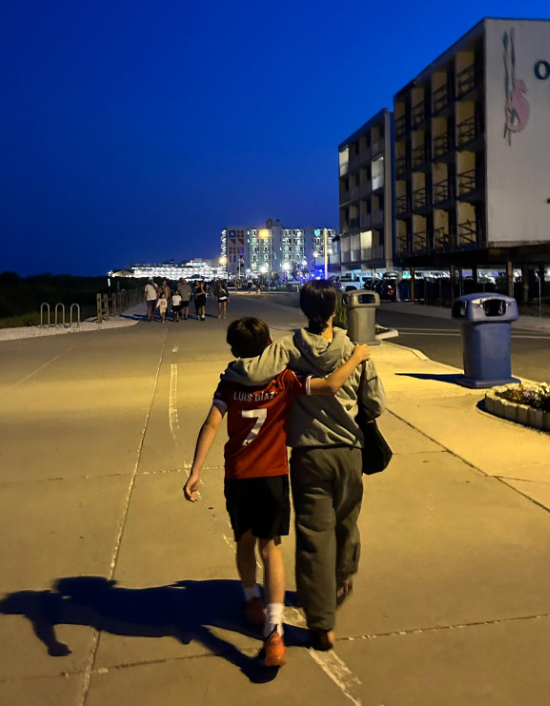
The thunderstorm rolled in fast Tuesday night, turning the Wildwood sky dark purple and sending everyone scurrying off the beach. Inside the rental house, Ella and Keigan sprawled on the kitchen floor. Chinese food containers sat between them, and The Radio Dept played softly from someone’s speaker as rain hammered on the sliding glass door. They weren’t doing anything particularly special, just laughing at something on their phones, but something about that moment felt different. Important, even. Like the kind of moment worth remembering precisely how the room smelled: like lo mein and ocean air, exactly how their laughter sounded over the thunder.
Some people think of meaningful vacations as family trips with matching t-shirts and carefully planned itineraries. But there’s something uniquely powerful about traveling with friends, especially during the transition from adolescence to adulthood. Research on summer experience reveals that breaks from routine can be transformative when they include meaningful engagement rather than isolation. Ron Fairchild, CEO of the National Summer Learning Association, notes that while there’s an “idyllic view of summer,” the reality depends heavily on what students actually do with that time. Quality experiences, whether educational programs or time with friends and family, create the kind of stimulation that prevents the boredom and stagnation many young people face during extended breaks.
Shaun Galbraith, who spent the week with the girls, puts it simply, “Good friends are family, and our family has always been very open to other people.” He explains that having Keigan there didn’t change the dynamic at all, “it was as if we had been on vacation with them our whole lives.” That openness, that blurring of lines between chosen family and biological family, is what made the week feel so natural.
For Ella and Keigan, that week in Wildwood wasn’t about escape; it was about presence. They’ve known each other since elementary school, the kind of friendship where one doesn’t have to explain herself because the other already knows. They’re like twins, each always able to read exactly how the other is feeling without a word being said. The week had a rhythm. One night, Shaun cooked dinner for everyone, something he says he loves doing because “I get to feed the ones I love, and there is always a laugh to be had.”
Emily Galbraith would laugh at the memory of the girls taking “absurd photos at absurd angles,” cackling about it the whole time. Those small moments, the ones that seemed silly, became the ones they couldn’t stop talking about later.
Those memorable moments are exactly why vacations are so important. Research provided by Allison Academy reveals just how important breaks are. Students and friends alike enjoy their freedom not only from homework and projects but also stress and mental health issues. Allison Academy explains how vacations are the perfect time for students to spend time with family and friends and have a mental reset to keep themselves healthy and happy. It doesn’t take a degree to recognize the benefits of vacations with friends.
So, whether it’s a cannonball into the pool or a hot chocolate by the fire, it is obvious that vacations and breaks are vital to the wellbeing of students. Moreso, it gives time for friends to live in the moment and embrace the memories they actively make together. Kids love the escape from schoolwork, but what really matters is the time spent creating stronger bonds filled with laughter and pure joy. The next time you take a vacation with a friend, remember how important it is to live in the moment and allow yourself to experience without regret.