From nostalgic tours inside the Crayola Factory to riding charter buses to the Metropolitan Museum of Art, field trips offer students an experiential learning experience with a fun twist. Oftentimes in the classroom, teachers rely on textbooks, PowerPoints, verbal teaching, or just letting the students self-teach through handing out papers with the expectation that they will be completed by the end of the block. As opposed to these methods of teaching, school field trips, no matter how educational they may appear on the surface level, help students not only gain greater knowledge through real-world experiences that may connect back to what they previously learned, but they also help students gain knowledge that passively learning has more difficulty conveying. For a school field trip to be approved, the teacher planning the trip must first reach out to the business either virtually or in person to not only see if the place they plan on going to approves their request but also allows the teacher to get a gauge as to what the trip would look like as far as the cost, a general timeframe of how long it would be, and a further understanding of how the field trip will benefit the students. Once the teacher gets approval from the place they want to visit, it must then be approved by the school, often by the principal; however, in some cases, such as overnight and international trips, it may have to then be approved by the school board to make sure that the trips do not risk the student’s safety, budgets the cost for transportation and admission, and aligns with district policies. Additionally, a permission slip must be given to all students who would be attending and signed by a parent or guardian to authorize the student’s participation and include the destination, date, the child’s medical conditions and allergies, and emergency contact.
Kaitlyn Scholl, a senior who has gone on multiple field trips including the Fashion, Marketing, and Merchandise field trip to King of Prussia and then two Child Development field trips, first to the AGA farms and then the Crayola Factory, says “I feel like every class should have a field trip because it shows more real world experiences and shows people what they want to do.” Scholl said that while her favorite part of field trips is not only getting to miss school, but also getting the chance to explore new places and experience the world outside of school; the worst part is having to listen to people talking about rules and guidelines. Although to some a trip like the King of Prussia may seem far from educational, Scholl noted that while there her teacher, Rachel Hoffman, showed them displays outside of the stores to show a real-world example of the lessons she teaches in her classes, which provides the students with a better understanding of what Hoffman was teaching them while also getting to go on a shopping spree afterwards.
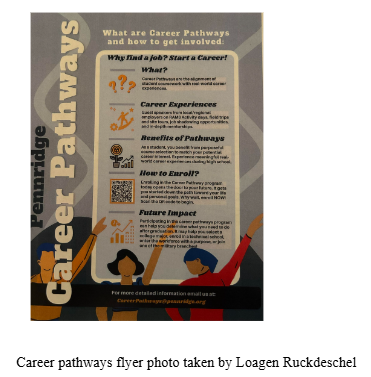
In addition to class field trips, Pennridge High School also offers students the opportunity to attend career pathway field trips, with the intention of enriching individual student interest in a specific career through hands-on experience. This experience involves working not only with equipment and materials, but also with professionals in that career field. According to Christopher Dyer, the Career Pathway Coordinator who works to create learning pathway opportunities for all students to help prepare them for their future, said that so far this year some of the field trips they have done includes attending St. Luke’s for sonography, the Penn Community Bank for business and finance, and the Bucks County Community College to participate in their healthy science career day. Looking towards the future, on Dec. 16, 2025, a respiratory therapy career field trip from 9:00 a.m. to 12:30 p.m. at Gwynedd-Mercy University will be offered for students interested in learning how people in these fields help patients to breathe more easily every day. Dyer explained that a typical career pathway field trip often begins with a short discussion or presentation about the company and different kinds of careers related to it followed by a tour and Q&A at the end. Dyer noted that when trying to plan a field trip, it is difficult “To match schedules with the business.”
While field trips have many advantages over standardized in-class learning, they do have their drawbacks. For starters, school field trips require a lot of careful planning of how the day will look and preparation of the budget that would go into it. In addition to creating permission slips, it may be too time-consuming for teachers and staff to undergo. An additional issue both the school and attendees face is the cost for the trip because while in some cases, such as the career pathway trips, they cost no money, for bigger trips requiring more preparation, such as transportation, admissions, and possible rooming if it is an overnight trip, the cost drastically increases, such as the New York City trip to see Wicked on Broadway in March 2026 with a cost of $185 to cover buses and tickets. However, to help counteract the cost, the Music Department has begun hosting small fundraisers and selling apparel to help cover the cost for at least the buses.